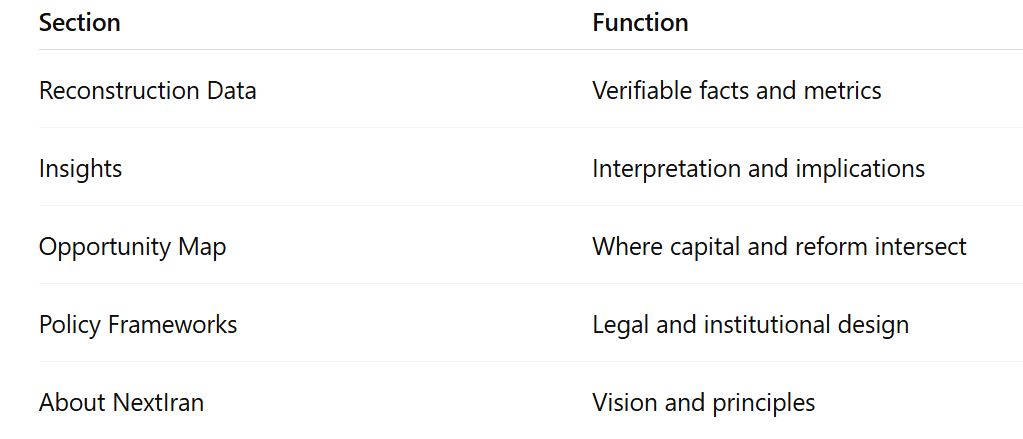
Insights is where NextIran connects the dots across economics, geopolitics, labor, energy, trade, and capital markets. It does not introduce new data, revise published figures, or contradict other sections of the site. Instead, it translates already-established facts into implications that matter for decision-makers.
If Reconstruction Data is the balance sheet, Insights is the analyst briefing.
Iran’s underperformance is often misread as structural weakness. The data shows the opposite. The country possesses:
One of the largest energy reserves globally
A young, educated, globally oriented population
Strategic geography linking Central Asia, the Caucasus, the Persian Gulf, and South Asia
An economy operating far below its natural capacity
The binding constraint is governance architecture, not human or natural capital. When rule-based systems replace discretionary control, output does not grow linearly — it rebounds sharply.
Insight: Iran is not a “developing economy problem.” It is a blocked economy problem.
Iran’s population structure is an outlier in the region:
Large working-age cohort
High urbanization
Strong appetite for global integration and private enterprise
Decades of exclusion from the global economy have created pent-up labor productivity. Once capital, trade, and entrepreneurship channels reopen, labor absorption will outpace most post-transition economies.
Insight: Labor supply will not constrain growth — institutions will.
Oil and gas remain Iran’s fastest monetizable assets. However, historical overreliance distorted incentives:
Crowded out private investment
Encouraged fiscal dependence
Delayed diversification
A future free-market Iran must treat energy as seed capital, not a permanent crutch.
Insight: Energy revenues should finance diversification, not substitute for it.
Iran sits at the intersection of:
East–West trade
North–South energy and goods corridors
Land routes connecting Central Asia to open seas
Trade-route economics favor countries that are predictable, neutral, and rules-based. Geography alone is insufficient; governance determines whether transit becomes rent-seeking or revenue-generating.
Insight: Iran can become a logistics hub — but only if friction is removed, not rearranged.
Past conversations established a core reality: Iran’s current currency has lost credibility. Any future monetary system must:
Be backed by openness, not slogans
Allow free pricing of capital and risk
Coexist with global currencies during transition
Insight: Confidence creates currency stability — not the other way around.
Global case studies are clear:
Capital avoids discretionary systems
Infrastructure without legal clarity decays
Growth without enforcement is temporary
Property rights, contract enforcement, and independent courts are not ideological preferences — they are economic infrastructure.
Insight: Roads and power plants matter, but courts and registries matter more.
A rule-based Iran integrated into global markets would:
Add trillions to long-term global GDP
Reduce regional volatility premiums
Rebalance trade routes away from monopolized chokepoints
Create a cooperative economic bloc aligned with Western markets
This is not zero-sum competition. Stability is expansionary.
Insight: Iran’s normalization is a global growth event, not a regional footnote.
Some argue Iran should emulate authoritarian, state-led growth models. The data disagrees:
Capital efficiency declines under opacity
Innovation stalls without competition
Political risk inflates financing costs
Iran’s advantage lies in aligning with open-market systems, particularly those of the United States and the European Union — not replicating the centralized approach of China.
Insight: Long-term prosperity follows transparency, not control.
Governments set rules; markets build outcomes.
Housing
Energy
Manufacturing
Logistics
Technology
All scale faster under competition than command. The role of the state is to enable, not replace, private execution.
Insight: The fastest reconstruction is the one governments do least of directly.
Every dataset reviewed points to the same conclusion:
Growth depends on predictability
Prosperity depends on openness
Stability depends on legitimacy
Ideology does not build economies. Systems do.
Insight: When economics is allowed to function, politics follows reality — not the reverse.
Each section has a defined role. None contradict the others.
Facts are not optional. Interpretation must be disciplined. Markets respond to reality.
Insights exists to ensure that Iran’s future is discussed not in slogans or grievances, but in economic truth.